
· Updated
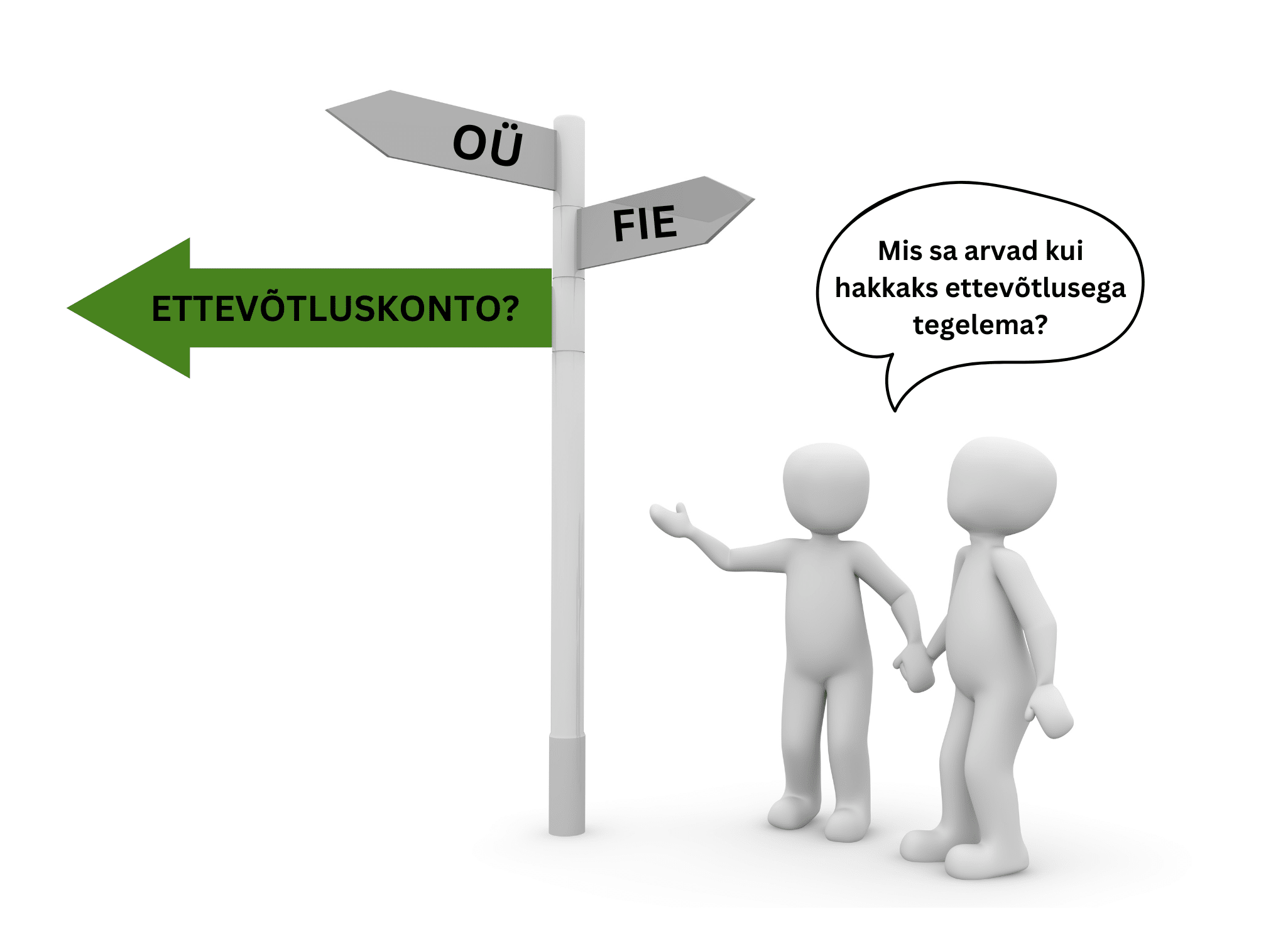
In this article we explain what a business account is: who it suits and who it does not, what to keep in mind when you have a business account and what opportunities it offers.
A business account (ettevõtluskonto) is a special bank account intended for natural persons to earn business income under simplified taxation. It is a good solution for small entrepreneurs who do not want to deal with accounting and tax calculations or find them complicated, because the bank automatically deducts the mandatory taxes from every payment received.
Features of the business account:
- Simplified tax calculation – 20% of the payments into the business account goes to taxes. From 2025, this also applies if annual income exceeds 25,000 euros, i.e. the higher 40 per cent tax rate has been abolished.
- The business account holder has joined the funded pension – in this case LHV Pank reserves business income tax from the amount received in the business account at a slightly higher rate, according to the funded pension contribution rate – either 22%, 24% or 26%.
- No need to register a business – the business account holder does not need to register as a sole proprietor (FIE) or set up a company.
- No need to keep accounts – all tax calculations are done automatically by the bank and the Estonian Tax and Customs Board (Maksu- ja Tolliamet, EMTA).
- Social insurance – the tax paid from the business account also includes a social tax component, but it counts towards the pension only if the taxes paid cover the minimum social tax obligation. In 2025, the monthly rate on which the minimum social tax obligation is based is 820 euros, which means that the minimum amount of social tax is 270.60 euros per month (€820 × 33%). For the social tax component to reach 270.60 euros, at least 2,255 euros a month must be received in the business account.
Who is the business account intended for?
Only private individuals can open a business account, as it was created for simplified tax calculation. The business account holder can also sell services and goods to legal persons, but if the business account holder sells services to legal persons (companies, institutions), the customer (i.e. the legal person) must additionally pay employment taxes. The business account is therefore better suited to selling services and goods to natural persons; services aimed at others may be more expensive and may not bring in enough profit to pay off.
A business account is recommended, for example, if you provide a service yourself (babysitting, private tutoring, etc.), provide services through various platforms (food courier, translation services, marketing services, etc.), sell handicrafts you have made yourself or rent out your property (your car, short-term rental of real estate).
A business account comes with no obligation to pay and declare taxes yourself, so it is very good at the start, but if providing the service also involves costs, it is better to set up a company, because costs cannot be deducted from the income received in the business account and tax incentives cannot be used.
Tax incentives that cannot be used with a business account:
- With an ordinary business (OÜ, FIE), material costs, work equipment, transport costs, rental costs, advertising costs, etc. can be deducted before taxation, but not with a business account.
- If goods or services are sold through a business account, you cannot be registered for VAT or reclaim VAT on purchases.
- A private limited company (OÜ) or sole proprietor (FIE) can depreciate purchased assets (e.g. equipment, cars) and record them as expenses, reducing taxable profit. With a business account, the full tax (20%) must be paid immediately, with no possibility of deferral.
- A business account does not allow you to hire employees, as it is intended for individuals. With an OÜ, the employer can in certain cases use tax incentives on labour costs, such as Unemployment Insurance Fund (Töötukassa) support.
- An OÜ can distribute profits as dividends, with an effective tax burden of 14–20% depending on how they are distributed. With a business account, the 20% tax is taken immediately, regardless of whether the money is withdrawn for personal use or not.
If the income in the business account exceeds 40,000 euros a year, the user has reached the VAT registration threshold and must move their activity into a business form (e.g. FIE or OÜ). Every business in Estonia is obliged to keep accounts, so if you start using another business form, you must prepare accounting reports and present all of the company's activities in the annual report. For this, it is important to choose a reliable partner for financial matters. People often look among their acquaintances for someone willing to file reports as cheaply as possible, without looking into the substance of the transactions and their actual accounting nature. Later, however, they are forced to put things right retroactively, which often does not turn out to be cheaper. We have long-standing experience and the ability to offer combined services, operating in Estonia, Latvia, Finland and Sweden. We take care of your company's accounting, payroll and tax calculations and help you obtain all the necessary licences and registrations when starting a business. Our motto is: a smart partner for a smart manager!
Declaring and reporting income from services provided abroad
If the business account receives income from a foreign customer (a private or legal person), the bank automatically deducts the business account tax and transfers it to the Estonian Tax and Customs Board. There is no need to submit an additional return, because the bank does the tax calculation for you. However, if you provide services to a foreign company, a tax liability may arise in that country. To clarify the tax requirements and avoid confusion, we recommend contacting our accountants.
It is also important to remember that:
- A business account can currently only be opened at LHV Pank. If you want to open one but are not an LHV Pank customer, open a private account there and you can then conclude a business account agreement.
- A business account holder cannot register as unemployed, as having a business account is treated as being in employment.
- Taxes on amounts received in the business account are calculated and deducted from the entire amount received, not from the profit.
- You are entitled to health insurance only if the taxes paid cover the minimum social tax obligation. In 2025, this means that at least 2,255 euros must be received in the business account every month to obtain health insurance.
- The tax paid from the business account includes a social tax component, but it counts towards the pension only if it covers the minimum obligation. If your income is below the minimum, you do not accumulate pensionable service.
Get help from a specialist
This article sets out the most important information on business accounts that is worth being aware of. It is always a good idea to discuss each individual case in more detail with our staff to avoid any possible misunderstanding or misinterpretation.