
· Updated

Several important changes to the Employment Contracts Act (töölepingu seadus) took effect on 1 August 2022. The changes were based on the European Union directive on transparent and predictable working conditions. The main purpose of the legislator's amendments is to give employees more information about their rights than before and greater opportunities to agree on suitable working conditions.
Informing employees of working conditions when concluding an employment contract
As a rule, an employment contract sets out the essential terms such as pay, working time, duties and place of work. Since 1 August 2022, under § 5 of the Employment Contracts Act, the employer has been obliged to give the employee more information about their working conditions than before. The written employment contract must also include the following:
1. Taxes and payments
In addition to the remuneration for the work and the procedure for paying it, the contract must also set out the taxes and payments paid and withheld by the employer, including a reference to the institutions to which the taxes and payments are made. The contract must also explain to the employee the protection that the taxes and payments provide; for example, in the case of social tax, the employee must be informed that this tax finances health insurance and the first- and second-pillar pensions and that it is paid to the Estonian Tax and Customs Board (Maksu- ja Tolliamet, EMTA).
The employer must therefore inform the employee of the following:
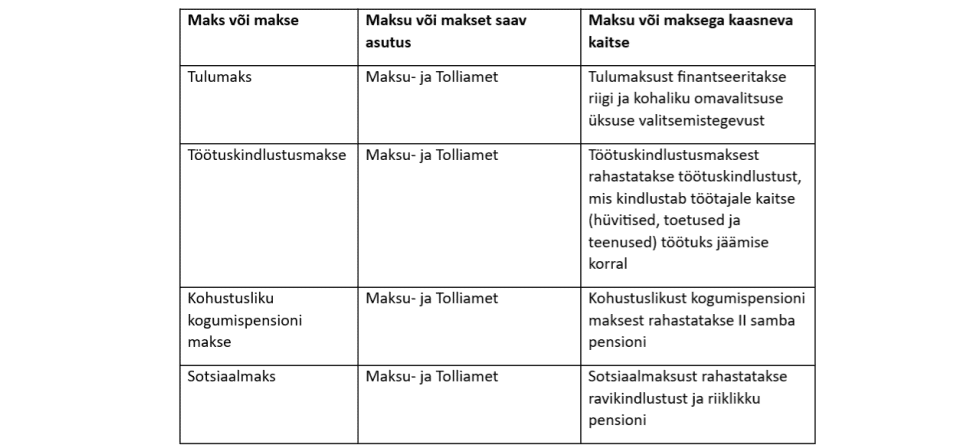
Source: Explanatory memorandum to the draft act amending the Employment Contracts Act, the Civil Service Act and the Working Conditions of Employees Posted to Estonia Act
2. Training
If the employer offers the employee training and other benefits, these must also be recorded in the employment contract. If the employer does not offer training, the employee does not need to be informed about it. The purpose of this provision is to ensure that the employee knows what training opportunities the employer offers and what the employer expects in terms of the employee's participation in training.
3. Holidays
In addition to the length of the annual holiday, the employment contract must inform the employee of other holidays compensated by the employer, the conditions under which the employee is entitled to such holidays and how that holiday is paid.
4. Termination of the employment contract
The contract must set out the rules for terminating the employment contract. While under the previous requirements the employment contract had to state the notice periods or refer to the basis on which the notice period is determined, under the amendments the contract must, in addition to the notice periods, also state that termination takes place in a form that can be reproduced in writing and explain the obligation to give reasons for termination.
The employer must always give reasons for termination, whereas the employee only has to give reasons if they wish to terminate the contract extraordinarily.
5. Work organisation rules
The employment contract must refer to the work organisation rules established by the employer.
6. Overtime
The contract must set out the procedure for working and compensating overtime – overtime is by agreement and is compensated either with time off or, if the parties agree, in money (at least 1.5 times the rate of pay).
7. Probationary period
The employment contract must also state the length of the probationary period.
If the employer breaches the obligation to inform, it may face a fine, which for a legal person can be up to EUR 32,000.
What about the employment contracts of employees hired earlier?
If an employee was hired on or after 1 August 2022, the written document of their employment contract (either the employment contract or an annex to it) must contain all the points listed above. The law does not require employment contracts with existing employees to be amended, but if an employee requests information on these terms, the employer is obliged to provide it.
Probationary period
In the new version of the Employment Contracts Act, the provisions on the probationary period have been gathered in a separate § 10¹. In addition to the fact that the length of the probationary period must now always be recorded in writing in the employment contract, it is good to know that under the new version of the act, the time during which the employee could not perform their duties, in particular because they were temporarily incapacitated for work or on holiday, is not counted towards the probationary period. The probationary period is extended by that time. The purpose of this section is to give both the employer and the employee enough time to make sure that the job suits the employee. If both the employee and the employer want the probationary period not to be extended by the time spent away from work, this must be agreed in the contract.
It is also important to know that when a fixed-term employment contract is extended or concluded consecutively for similar work, a new probationary period cannot be applied.
Adverse treatment
The new version of the act contains a new section aimed at protecting employees from adverse treatment. An employee must not be treated adversely because they defend their rights, draw attention to violations of those rights or support a colleague in defending their rights. For example, if the employee has worked overtime but the employer refuses to compensate it.
To assess adverse treatment, the employee's situation is compared with their own previous situation, not with other people or groups. While the previous law focused on the prohibition of discrimination on grounds of gender or ethnicity, the grounds for unequal treatment are now broader. In short, the employer is obliged to treat employees with similar responsibilities and duties in the same way.
Working under suitable conditions
The directive introduced two principles that the employer must follow, which are regulated by the new § 18¹ added to the Employment Contracts Act.
1. Requesting suitable working conditions
The employee has the right to request suitable working conditions from the employer. The law specifically states that the employee has the right to request work under an employment contract for an unspecified term or full-time work. The employer is obliged to consider whether the employee's request can be granted. If the employer refuses, it must reply to the employee in a form that can be reproduced in writing within 14 calendar days (2 weeks). If the employee submits more than one request for suitable working conditions within four months, the employer has the right not to respond to them.
2. Working for another employer
The amendment clarifies that the employer can no longer prohibit the employee from working for another employer outside working hours. Working for another employer can nevertheless be restricted, where necessary, by a non-competition agreement. The law lays down precise requirements for such an agreement (§ 23 of the Employment Contracts Act). If they are not met, the agreement is void.
Payment of holiday pay
Unless the employer and the employee have agreed otherwise, holiday pay is paid to the employee no later than on the penultimate calendar working day (calendar working days: Monday to Friday) before the holiday. So, for example, if the employee's holiday starts on a Wednesday, holiday pay must be paid no later than on the Monday.
In summary
Under the new version of the act, the amount of information the employer must give the employee in writing when they start work is considerably greater than before. The regulation of the probationary period changed: the new features are the suspension of the probationary period and restrictions on applying a probationary period. Employees gained the right to request flexible and suitable working conditions, and provisions on adverse treatment were added. The procedure for paying holiday pay was also clarified. The list of legislative changes above is not exhaustive, but we have highlighted the main points that concern all Estonian companies.